
Rodent Exclusion & Rodent Proofing in Waco, TX
The part of rodent control that actually stops the cycle — every gap found, photographed and sealed with materials rats and mice cannot chew through.
Call (855) 591-1339 — Free InspectionIf you only trap rodents, you will be trapping them again next season. Rats and mice follow scent trails to the same openings their family used before. Rodent exclusion — sometimes called rodent proofing — is the work of finding every one of those openings and closing it permanently.
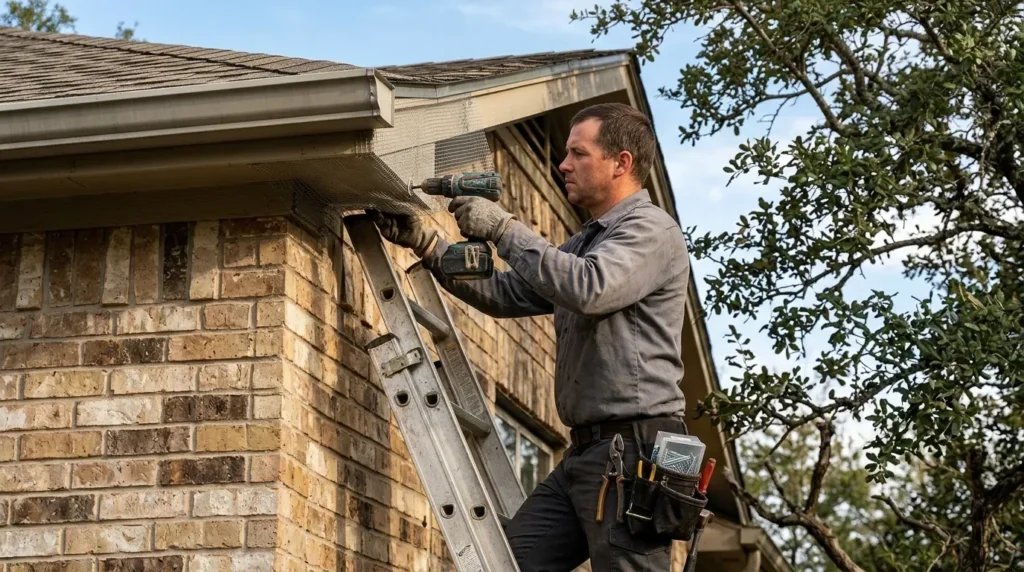
This is the single most important part of rodent control, and it is the part most companies skip or rush.
Where Rodents Get Into Waco Homes
Every house is different, but these are the openings providers seal most often in McLennan County:
| Entry point | Common in | What providers use |
|---|---|---|
| Roof returns and soffit gaps | Two-story and newer homes in Woodway, Hewitt | Sheet metal flashing, hardware cloth |
| Gable and attic vents | Older homes near Baylor, Sanger Heights | ¼-inch galvanized hardware cloth |
| Plumbing roof stacks | All homes | Stainless steel stack guards |
| A/C and plumbing line sets | Slab homes across Waco | Copper mesh + elastomeric sealant |
| Weep holes in brick | Brick veneer homes | Stainless weep-hole covers (keep drainage open) |
| Garage door corners and seals | All homes | Rodent-proof door seals and corner guards |
| Crawl space vents and skirting | Pier-and-beam homes, mobile homes | Hardware cloth, vent covers |
| Foundation cracks and pipe penetrations | Homes on Waco’s shifting clay soil | Mortar or concrete patch |
Why Foam Alone Fails
Expanding foam is fast and cheap, which is why it is so common. Rats chew straight through it, and Texas heat and UV make it crumble within a few seasons. Providers use foam only as a backer inside a metal or mesh repair — never as the repair itself.
Built for Waco Weather
Waco summers regularly reach the upper 90s and above, and attic temperatures run far higher. Cheap silicone and foam shrink and crack. Waco’s expansive clay soil also shifts foundations, reopening cracks. Providers use galvanized and stainless metals and flexible, exterior-grade sealants that tolerate movement and heat.
Hearing scratching at night or smelling something dead? Get connected with a local Waco rodent pro today.
Call (855) 591-1339 Free referral call · Ask for a written price before any work
The Exclusion Process
- Full inspection — roofline, attic, exterior walls, foundation, garage, crawl space. Every gap is photographed.
- Rodent removal first — providers trap the active rodents before sealing, so none are trapped inside to die in the walls.
- Sealing — every opening closed with the right material for its size and location.
- Photo report — you see each repair before and after.
- Follow-up check — providers confirm there is no new activity.
See the full 6-step process.
Rat Proofing vs. Mouse Proofing
Rats need a gap about the size of a quarter; mice need one about the size of a dime. Rat proofing focuses on stronger materials — sheet metal and heavy mesh — at the roofline and foundation. Mouse proofing goes after the smaller gaps around doors, weep holes and utility lines. Most Waco homes need both. Read about rat removal and mice removal.
Rodent Proofing for New Homeowners and Pre-Season Prevention
Just bought a home? Have not had a problem yet but your neighbors have? A preventive rodent proofing visit before the November cold snap is the cheapest time to deal with rodents — before they are inside.
Other Rodent Services in Waco
Roof rats and Norway rats trapped and sealed out
House mice and deer mice out of walls, kitchens and attics
Attic and roofline work for Waco’s climbing rats
Droppings, nests and soiled insulation removed
Dead Rat & Dead Animal Removal
Smell located, carcass removed, area deodorized
Pier-and-beam homes sealed and cleaned
Restaurants, warehouses and offices
Rental & Airbnb Rodent Control
Landlords, property managers and short-term hosts
Before & After: Mice in the Garage
 BeforeAfter
Mice in the Garage
Droppings and chewed boxes around the dryer vent. Cleaned out and the vent mouse-proofed with a steel guard. Rodent Exclusion →
Common Entry Points Providers Seal in Waco Homes
| Entry point | Who uses it | How providers seal it |
|---|---|---|
| Roof returns and fascia gaps | Roof rats | Sheet metal and hardware cloth |
| Gable and soffit vents | Roof rats | Heavy vent screen |
| Weep holes | Mice | Stainless weep-hole screens |
| A/C line sets and pipes | Mice and rats | Copper mesh and sealant |
| Garage door corners | Mice | New seals and rodent-proof corners |
| Crawl space vents and skirting | Norway rats | Hardware cloth and repairs |
| Dryer vents | Mice | Steel vent guards |
Why Steel, Not Foam
Expanding foam is fast and cheap, which is why many companies use it. Rodents chew through it in a night. Texas heat also breaks it down. Providers use galvanized hardware cloth, sheet metal, copper mesh and exterior sealant, so the repair outlasts the rodents.
More Questions Waco Homeowners Ask
How long does rodent-proofing take?
Many single-family homes take one to two days of exclusion work, depending on roof complexity, crawl space access and the number of gaps. Larger or older homes can take longer. Ask the provider for a timeline along with the written price.
Why do new gaps keep opening in Waco homes?
Much of the Waco area sits on expansive clay soil that shrinks during summer drought and swells after heavy rain. That movement can open gaps at the foundation, around door frames and where pipes enter the slab. It is worth re-checking exclusion work after a long, dry summer.
FAQ – Rodent Exclusion in Waco
How much does rodent exclusion cost?
It depends on the number and type of entry points. A newer slab home may need a handful of repairs; an older pier-and-beam home can need many more. Providers inspect free and give you a fixed price.
How long does exclusion work last?
Metal and mesh repairs installed correctly last for many years. Providers recommend a quick check after major storms or roof work.
Do you seal while rodents are still inside?
No. Providers remove active rodents first. Sealing them in creates dead-rodent smells and new chewing damage.
Will sealing weep holes cause moisture problems?
Not with the right product. Providers use vented weep-hole covers that keep water draining but block rodents.
Can I do rodent proofing myself?
You can seal obvious gaps at ground level. Rooflines, soffits and attic vents are where most rats and mice get in, and those need ladders, experience and the right materials.
Garages and Sheds
Garages and sheds are where many Waco rodent problems start. They are full of shelter and often hold the food: pet food, birdseed, grass seed and feed. Mice then move from the garage into the house through the shared wall.
- Replace worn garage door bottom seals and add side brush seals
- Seal the gap where the door frame meets the slab
- Put a metal kick plate or hardware cloth on wooden shed doors rodents have chewed
- Bury an L-shaped wire skirt around sheds on blocks so rats cannot dig under
- Store feed and seed in metal bins with tight lids
- Keep items on shelves, off the floor, so you can see droppings early
If you find droppings in a closed shed, see safe droppings cleanup before you sweep anything.
What Is Exclusion Pest Control?
Exclusion pest control means keeping pests out by physically closing the ways they get in, instead of relying only on traps or chemicals. For rodents, that means sealing gaps, screening vents and protecting the spots where pipes and wires enter the house. It is the step that stops the problem from coming back.
How Small a Hole Can a Mouse Fit Through?
The CDC says a mouse can fit through a hole the width of a pencil, about 1/4 inch. Cooperative Extension guidance says rats can get through openings larger than about 1/2 inch. If you can slide a pencil into a gap, a mouse can use it.
Room-by-Room Rodent Sealing Checklist
| Area | What to check | Typical fix |
|---|---|---|
| Kitchen | Gaps around pipes under the sink, behind the stove and refrigerator, cabinet backs | Steel wool plus caulk or foam |
| Laundry | Dryer vent, gaps around washer hoses and drain lines | Vent guard, sealant |
| Garage | Bottom corners of the door, door seal, wall-to-slab joint | New door seal, rodent-proof corner pieces |
| Attic | Gable and soffit vents, roof-to-wall junction, plumbing vents | Hardware cloth, metal flashing |
| Exterior walls | A/C line set, cable and gas entries, weep holes | Sealant, metal mesh, weep vents |
| Crawl space | Vents, access door, foundation gaps | Hardware cloth, cement |
| Bathrooms | Gaps around pipes under vanities and behind toilets, tub access panels | Steel wool plus caulk, escutcheon plates |
| Water heater closet | Gaps where water, gas and vent lines pass through walls or floor | Steel wool plus caulk, metal collars |
| Exterior doors | Gap under the door; keep it to about 1/4 inch or less | Door sweep or threshold |
| Yard | Branches touching the roof, woodpiles, dense ground cover against the house | Trim limbs, move woodpiles, clear vegetation |
Sources: CDC: Seal Up, Cooperative Extension: Rodent-Proof Construction.
More guides: how high rats jump · trapping guide
See also: do rodent repellents work
Explore Rodent Control in Waco
Services
Waco Neighborhoods
Nearby Cities
Rodent Guides
Ready to get rodents out for good? Get connected with a local Waco rodent pro now.
Call (855) 591-1339 Free referral call · Ask for a written price before any work